Politics often collapses under the weight of slogans. Governing does not. Governing is the art of choosing between scarce resources, imperfect options and uncomfortable truths. Britain has reached the point where reality has overtaken rhetoric. The prison estate in England and Wales is effectively full. Emergency early release has become an instrument of necessity rather than choice, and ministers are confronted with a question no government wishes to answer: who should remain behind bars when there are not enough cells for everyone?
Where are we now, and how did we get here?
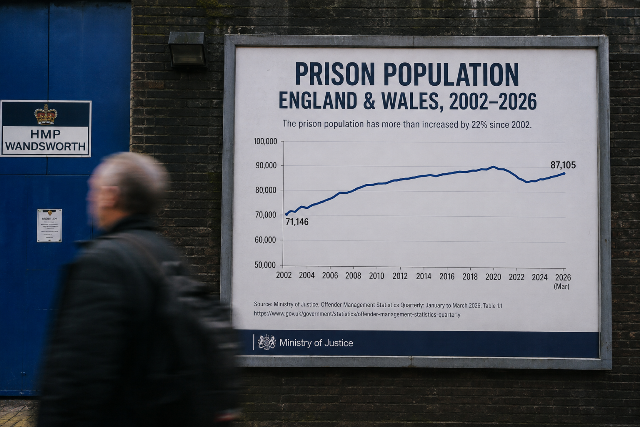
The prison crisis did not arrive overnight. It has accumulated over more than two decades. Parliament steadily expanded the demand for prison places through longer sentences, new offences and stricter release arrangements. Capacity never kept pace. The chart above tells the story: not a temporary fluctuation, but a structural imbalance that successive governments inherited and, despite repeated commitments, failed to resolve. Year by year the margin narrowed. Year by year the pressure grew. Eventually arithmetic asserted itself.
The debate has largely centred on whether prisoners should be released early. I believe that begins in the wrong place. A better starting point is both simpler and more uncomfortable.
Every prison place has an opportunity cost.
A prison cell is more than a punishment. It is a scarce public asset. Occupy it with one offender and it cannot simultaneously contain another. Economics teaches this lesson in its opening lecture; public policy has an unfortunate habit of forgetting it before the first press conference.
Whenever governments imprison one category of offender, they are making an implicit decision about whom they may eventually have to release instead. There is no escaping this arithmetic. One cannot spend the same pound twice. Nor can one occupy the same prison cell twice.
Yet our politics continues to behave as though prison capacity were an inexhaustible moral resource. It is not. It is finite. And when something is finite, priorities cease to be philosophical and become practical.
That principle ought to guide every discussion about sentencing.
If prison places are scarce, they should first be reserved for those who present the greatest danger to ordinary people: violent offenders, sexual offenders, persistent domestic abusers and those whose crimes leave clear, identifiable victims. Everything else is secondary.
This is not softness. It is triage.
Nobody entering an overcrowded emergency department expects doctors to treat a sprained ankle before a heart attack simply because the ankle patient arrived first. Scarcity demands prioritisation. So does justice.
Yet England and Wales continue to imprison thousands of people for drug offences. Government statistics show that roughly 9,000 prisoners are serving sentences for drug offences—around one in eight sentenced prisoners. Many are undoubtedly dangerous organised criminals who belong behind bars. Others, however, are non-violent offenders whose continued imprisonment consumes precisely the prison capacity now forcing ministers into politically toxic decisions about early release.
Every one of those prison places carries an unseen cost. It may be the prison place unavailable for:
- a repeat violent offender.
- a dangerous domestic abuser.
- someone convicted of rape.
Opportunity costs are invisible until the system runs out of room. Then they become painfully visible indeed.
The present crisis has exposed precisely that contradiction. Ministers have found themselves contemplating the early release of offenders convicted of serious violence because the estate has reached breaking point. Recent revisions to emergency release schemes have excluded some of the most serious sexual offenders after public concern, yet difficult decisions remain because the underlying shortage of capacity has not disappeared.
One may sympathise with ministers. Arithmetic is an unforgiving political opponent.
But arithmetic is also politically impartial.
As someone whose academic work concerns sustainability, I instinctively view institutions as systems rather than isolated events. Sustainable systems allocate scarce resources where they generate the greatest public benefit. Unsustainable systems consume those resources until crisis forces improvisation. Britain's prison system increasingly resembles the latter.
We have reached the point where one of the most expensive assets in the criminal justice system is being rationed in emergency conditions. The annual cost of keeping one prisoner now exceeds £50,000. Yet the public conversation still treats imprisonment as though it were costless, limitless and universally applicable. It is none of those things.
There is an even wider question hiding beneath the immediate crisis. For decades we have imprisoned thousands of people in the name of drug prohibition, yet our streets remain awash with the very substances that cause the greatest misery: cocaine, heroin, crack cocaine and an ever-growing range of potent synthetic drugs. Drug prohibition has not abolished the drug market. It has merely determined who owns it, because when governments prohibit a product for which substantial demand remains, they do not eliminate commerce; they transfer commerce into criminal hands. Organised crime does not create this opportunity. It inherits it.
County lines networks, organised criminal gangs and sophisticated trafficking operations exist because illegal markets generate extraordinary returns while insulating suppliers from legitimate competition. HM Inspectorate of Prisons continues to report that organised crime groups exploit prisons themselves, using drones, mobile phones and widespread drug availability to strengthen their operations even within supposedly secure institutions.
Whether one supports wider drug reform or opposes it is, in one sense, beside the point. The prison crisis raises a narrower and more immediate question. If thousands of prison places must somehow be found, where can they be found with the least additional risk to the public?
That question should be answered by first principles.
Every prison place occupied by someone presenting relatively low direct risk is a prison place unavailable for someone presenting much greater risk. Its an investment made on behalf of public safety. Wisdom lies in investing first where the return is greatest: keeping the most dangerous offenders away from the public.
Please understand this is fundamentally not a debate about drugs. It is a debate about victims.
The first duty of the criminal justice system is not to maximise punishment in the abstract. It is to minimise victimisation in the real world. If prison capacity is insufficient—and every official assessment now indicates that it is under severe strain—then scarce prison places should be allocated where they prevent the greatest amount of harm.
History repeatedly shows governments changing long-established policies not because opinion shifted first, but because circumstances made old assumptions impossible to sustain. Fiscal crises reshape budgets. Wars reshape alliances. Institutional crises reshape laws.
Perhaps the prison crisis will eventually reshape sentencing. Perhaps it should. For the question that now confronts Britain is not whether prisons are full. They are. Nor is it whether difficult choices must be made. They must.
History has little patience for systems that refuse to adapt to reality. Britain's prison estate now demands a first principle worthy of the challenge: every prison place has an opportunity cost. Everything that follows in sentencing policy should follow from that single truth.
The question is whether we possess the courage to make those choices according to a principle simple enough for every citizen to understand and serious enough for every government to remember.
Every prison place has an opportunity cost.
If we cannot imprison everyone, then we should imprison first those from whom the public most urgently needs protection.
Everything else is commentary.